
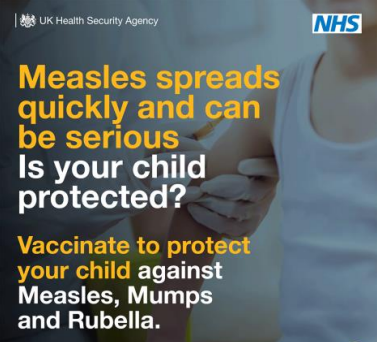
Liverpool City Council is joining health partners across Merseyside and the UK in urging residents to check their own and their child’s vaccination status following a rise in measles cases across the region.
Measles is a highly contagious viral infection that spreads through coughing, sneezing, and close contact.
It can cause serious complications such as pneumonia and meningitis.
Vulnerable groups such as babies, pregnant women, and individuals with weakened immune systems are especially at risk.
The most effective way to protect yourself and your child against measles, mumps, and rubella is to have 2 doses of the MMR vaccine.
It offers lifelong protection and is available for free on the NHS.
It is usually given in two doses first at 12 months of age and again at around three years and four months.
Children who have missed their MMR vaccine can receive both doses at any age.
Adults who haven’t been vaccinated are also eligible for catch-up doses.
Symptoms of measles appear 7-10 days after contact with the virus and include:
- Cold-like symptoms such as runny or blocked nose, sneezing and cough
- red, sore, watery eyes
- high temperature (fever), which may reach around 40OC / 104OF
- Non-itchy, red-brown rash usually appears 3-5 days later (sometimes starts around the ears before spreading to rest of the body), spots may be raised and join to form blotchy patches which may be harder to see on darker skin tones
- Small white spots may appear inside cheeks and the back of lips (for a few days)
What to do if someone suspects they or their child has measles:
- Phone a GP or NHS 111 for advice
- Do not go directly to the GP practice or another healthcare setting
- Children should not go to school or childcare
- Avoid contact with vulnerable groups such as babies, pregnant women, and people with weakened immune systems
- Practise good hygiene, including frequent handwashing and using tissues when sneezing
For further information about measles visit: Measles – NHS
Professor Matt Ashton, Director of Public Health for Liverpool, said: “Two doses of the MMR vaccine is one of the most reliable and proven ways to protect yourself against measles, mumps and rubella.
“It’s never too late to get vaccinated and with uptake levels worryingly low, it’s more important than ever that people check their own and their child’s vaccination status and book catch-up doses if needed.”
Nathan Askew, Chief Nurse at Alder Hey Children’s NHS Foundation Trust said:
“We are seeing more children and young people with measles here at Alder Hey and we are looking after some very poorly children at the moment.
“Children and young people are really vulnerable and it’s so important to protect them from serious illnesses like measles. It’s very easy to get vaccinated and it’s the safest and best defence against measles.
“Just two doses of the MMR vaccine will give lifelong protection against measles, mumps and rubella. Please protect yourself and our children and young people by getting vaccinated.”
Dr Merav Kliner, Deputy Director for UKHSA North West said:
“With declines in childhood vaccine uptake, including MMR, observed in many countries around the world over the last decade, exacerbated by the COVID-19 pandemic, we are now seeing the impact of this with large measles outbreaks globally including recently in Europe and England last year.
“Measles is one of the most highly infectious diseases and spreads rapidly among those who are unvaccinated and is often the canary in the coalmine for vaccine preventable diseases.
“We are concerned that this could be an early warning sign of other possible disease outbreaks both globally and here at home, especially over the summer months as families with unvaccinated children and adults travel to countries where diseases are endemic or outbreaks are occurring.
“That is why It is important that anyone travelling for summer holidays or to visit family, especially parents of young children, check that all members of their family are up to date with all their vaccines, especially MMR vaccines.”