
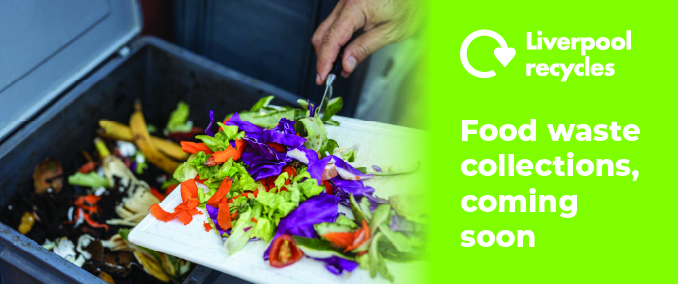
From September, select households in Liverpool will begin to receive free, weekly food waste collections as the Council rolls out its newest recycling initiative.
Approximately 15,000 properties are set to benefit, marking a major step towards reducing waste and increasing the city’s recycling rates – which are currently among the lowest in the UK.
The properties have been chosen from 15 wards, including Childwall, Garston, Fazakerley West and West Derby.
Those who are among the first to receive the new service will be notified next month and will receive information packs, a smaller indoor bin (known as a caddy), a larger outdoor caddy, and odourless liners ahead of the launch on Monday, 22 September.
All food waste will be able to be recycled, including leftovers, vegetable peelings, bones, and teabags.
The outdoor caddies will be pest-proof, meaning that rats, seagulls, and other unwanted pests will be unable to get inside.
The new food waste collections are an additional service and will be collected on the same day as the purple and blue bins. There will be no changes to the existing bin collection schedules.
A phased roll-out will then be extended across the city enabling the Council to test vehicle capacity, routes and gain an early understanding of the amount of food waste being recycled.
Recent research has found that approximately one third of all rubbish thrown away in purple bins is food waste, that could be recycled.
WHAT HAPPENS TO THE FOOD WASTE?
- Once collected, the food will be taken away to be recycled via a process called anaerobic digestion.
- This is where microorganisms break down the waste in an enclosed space. As they do so, the waste releases methane gas, which is collected and converted into a biogas that can be used to generate electricity, heat, or transport fuels.
- Additionally, the waste leaves behind a nutrient-rich digestate that can be used as a fertiliser – similar to home composting.
DID YOU KNOW?
- The United Nations estimate that food waste is contributes 8-10 per cent of global man-made greenhouse gas emissions. If food waste were a country, it would be the world’s third largest emitter after China and the USA.
- Recent research also found that just 17.9 per cent of rubbish in the Liverpool was recycled, while approximately one third of all purple bin contents is classed as food waste.
- The Council introduced a new Recycling and Waste Strategy earlier this year, which sets out steps the city will take to reduce these harmful emissions over the next five years.
Councillor Laura Robertson-Collins, Cabinet Member for Communities, Neighbourhoods and Streetscene said: “This is an incredibly exciting time for the city. We all produce food waste and some of it is inevitable for many of us, like teabags, chicken bones and vegetable peelings.
“With the introduction of weekly food waste collections, we’ll now be able to put it to good use rather than sending it to be incinerated with the rest of our household waste. Not only will this help reduce carbon emissions, but it also creates products that could be used to heat homes or power vehicles.
“These food waste collections will eventually be rolled out across the city for everyone to take part. They’ll be completely free and won’t impact other scheduled bin collections.
“We’ll be working closely with households across each phase of the roll out to help make the introduction as smooth as possible. I’d strongly encourage everyone to start recycling their food waste as soon as they’re able to.”